Spacelift Intent»
Spacelift Intent lets you provision and manage infrastructure by describing what you need in natural language. Instead of writing Terraform/OpenTofu code, your AI client calls Spacelift Intent, which directly interacts with provider schemas under Spacelift's guardrails (policies, audit trail, state, permissions).
You reach Intent through the Spacelift MCP server from your own AI client, or through Infra Assistant inside the Spacelift UI.
Key concepts»
- Natural language: Describe your infrastructure needs in natural language; Intent translates it directly into the infrastructure you want.
- Policies: Spacelift enforces governance (OPA/Rego policies) before execution to deny unsafe operations and allow compliant ones.
- State & audit built-in: Centralize state management and view the complete operation history without manual backend configuration.
- Separate policy writing & resource changes: With spaces and our access control features, you can assign precise roles and permissions so authors and operators stay clearly separated.
High-level architecture»
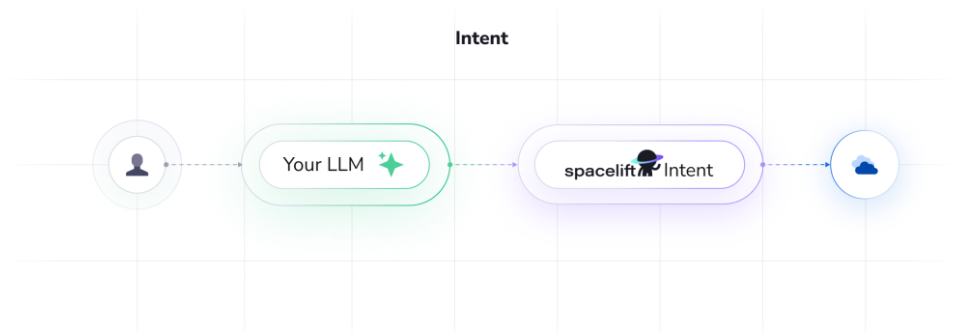
Spacelift Intent connects your AI client to your cloud infrastructure through a secure, policy-governed pipeline:
- MCP Client (Claude Code, ChatGPT, VS Code, etc.): You describe infrastructure in natural language.
- Spacelift MCP Server (the
/mcpendpoint): Translates requests into provider operations, discovers Terraform providers from OpenTofu registry, learns resource schemas. The same endpoint also exposes the full Spacelift GraphQL API for general-purpose automation. - Spacelift Control Plane: Enforces policies (OPA/Rego), manages state, records audit history, handles cloud authentication, provides resource visibility.
- Cloud Providers (AWS, etc.): Executes approved operations via cloud integrations with scoped permissions.
Key flow»
- You send a natural language prompt describing infrastructure changes.
- Intent interprets the request, discovers relevant Terraform providers from the OpenTofu registry, and learns their schemas to plan operations.
- Attached policies then evaluate the plan against governance rules, allowing or denying based on resource types, operations, or attributes.
- If approved, Intent executes changes via cloud integrations with scoped credentials.
- State updates automatically and full operation history is recorded for audit.
Prerequisites»
- Claude Code or similar MCP client.
- Spacelift account with access to Intent, in any space where you have permission to manage Intent projects.
- (Optional for AWS tests) An AWS account
- AWS integration configured in Spacelift if you plan to create AWS resources
Where to next»
- Get started with Intent: connect a client, create a project, and provision your first resources.
- Working with projects: policies, cloud integrations, importing, deleting, and session safety.
- Deploying Spacelift modules: deploy a module from your registry as a single managed resource.
- Execution and access control: worker pools, runner images, and RBAC.
- Intent to IaC: export your project to Terraform/OpenTofu.
- Setting up Azure and GCP credentials
- Handy commands and prompts
- Troubleshooting and FAQ